Announcing the Mehta Wahi LLM Scholarship
The Mehta Wahi Scholarship supports an LLM student at Seattle University with demonstrated interest in South Asia–related legal, social, or policy issues, advancing global legal education and cross-border dialogue.
/73x0:1847x1080/prod01/channel_34/media/seattle-university/roundglass-india-center/Mehta-Wahi-Scholarship-(1).png)
Academic and Research Programs
The Roundglass India Center supports a range of academic and research programs, including student exchanges, faculty grants, and the Access to Justice project.
/0x86:6000x3914/prod01/channel_34/media/seattle-university/roundglass-india-center/Faculty_Research_Symposium_KP_026.jpg)
Learn more about the Center's academic and research programs below.
.png)
The Raman Family Faculty Grants, named in honor of a generous gift from Suri and Mala Raman, advance faculty scholarship on India, South Asia, and Indian and South Asian Americans in all academic disciplines. Awards are offered in two categories: (1) Research Projects advancing inquiry connected to India or South Asia, and (2) Course Development to build or significantly revise India-focused curricula. Full-time faculty in all disciplines are encouraged to apply.
The funds are designed to support seasoned scholars of South Asian Studies while encouraging new faculty to expand their research or coursework into topics relevant to India. Through this program, we educate about India and its diaspora—and give back by investing in faculty scholarship and student learning opportunities.
| 2026 AWARDS |
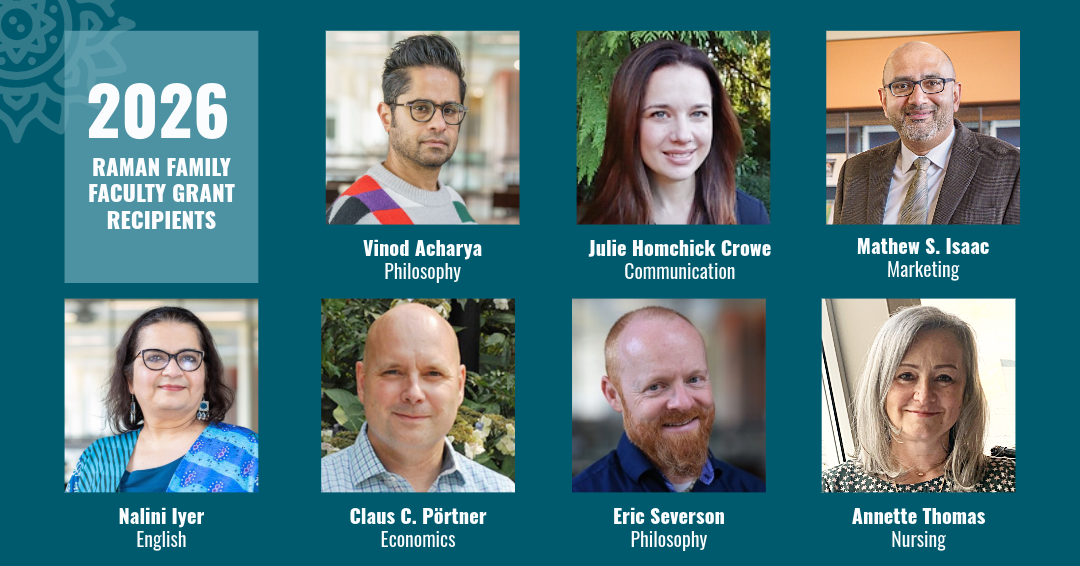
- Vinod Acharya, Philosophy | UCOR Course: Politics, Identity and Belonging in India and South Asian Diaspora
- Julie Homchick Crowe, Communication | Heritage and Health: Yoga, National Identity, and Hindu Nationalism in Modern India
- Mathew Isaac, Marketing | Collaborative Research Incubator for Consumer Behavior Scholars from India and the United States
- Nalini Iyer, English | Mother–Daughter Collaboration in the Fiction of Anita and Kiran Desai
- Claus Pörtner, Economics | Institutional Shocks and Biological Vulnerability: Disentangling India’s Shifting Sex Ratios
- Eric Severson, Philosophy | India-Based Research for A Monster’s Guide to World Philosophy
- Annette Thomas, Nursing | UCOR Course: Introduction to Global Health: India
| 2025 AWARDS |
- Tapoja Chaudhuri, Anthropology | Environmental anthropologist Tapoja Chaudhuri will extend her qualitative research on climate change and philanthropy beyond the PNW to interview diasporic activists and non-profit volunteers engaged in climate-impacted communities in India.
- Rebecca Cobb, Couples and Family Therapy | Clinical Professor Becky Cobb will co-edit the third edition of one of the foundational textbooks in marriage and family therapy and will use these funds to explore how to apply the approaches in the book in a culturally attuned way.
- Nalini Iyer, English | The funds support international travel for South Asian literary scholar Nalini Iyer to moderate two panels on intersectionality in South Asian diasporic writing at the European Conference on South Asian Studies in Heidelberg, Germany. The papers presented on these panels will likely form the core of a book to be published with Routledge India on South Asian Literature.
- Sonora Jha, Communications | 2024 WA State Book Award Fiction Prize Winner Sonora Jha will do research to revise and support the 2026 U.S. edition of her novel Foreign (first published in 2013 by Random House India).
- Meenakshi Rishi, Economics | Rishi will use the funds for domestic travel within India to collaborate with Ruchira Sen, Associate Professor of Economics at Jindal Global University, on a new line of research on women’s participation in the Indian labor force.
- Annette Thomas, Nursing | A team of nursing faculty members, including clinical professor Thomas, will develop a global health immersion program in India.
| 2024 AWARDS |
Watch the event recording of the Faculty Research Symposium to learn more about these projects.
- Tapoja Chaudhuri, Anthropology | Climate Change and Philanthropy: A focus on the Indian diaspora in the PNW
- Rashmi Chordiya, Public Affairs and Nonprofit Leadership | Liberatory Public Service in Action: Case Studies from the United States and India
- Rebecca Cobb, Couples and Family Therapy | Moksha Patam: Adaptation of an Ancient Indian Game for Culturally Relevant Teletherapy Intervention
- Mathew Isaac, Marketing | Cherished Numbers: Do Preferred or Auspicious Numerical Values Influence
Marketplace Judgments in the U.S. and India? - Sonora Jha, Communication | Intersections of Caste, Disability, and the Female Body in India
- Meenakshi Rishi, Economics | Keynote Lecture at Global Finance Conclave at Jindal Global University
.png)
The Mehta Wahi Scholarship supports an incoming LLM student at Seattle University School of Law with a demonstrated interest in South Asia–related legal, social, or policy issues. Established through the generosity of Pallavi Mehta Wahi and Ash Wahi, the scholarship reflects a shared commitment to expanding access to advanced legal education and strengthening cross-border legal understanding.
Designed to prepare globally engaged legal leaders, the scholarship recognizes the importance of equipping internationally trained lawyers to work across legal systems, cultures, and jurisdictions. Recipients join a nationally recognized LLM program known for its emphasis on access to justice, public service, and experiential learning.
Administered in partnership with the Roundglass India Center, the Mehta Wahi Scholarship advances the Center’s mission to deepen teaching, research, and dialogue related to India and the Indian diaspora. By supporting emerging legal scholars focused on South Asia, the program fosters meaningful global exchange and contributes to Seattle University’s Jesuit commitment to educating leaders for a just and humane world.
How to Apply
Step 1: Apply to the Roundglass India Center
Deadline: March 31, 2026
Email the following materials to the Roundglass India Center:
- CV or résumé
- Academic transcripts (unofficial copies acceptable at this stage)
- Statement of interest (500–750 words) addressing:
- Your engagement with South Asia–related legal, social, or policy issues
- Your professional goals
- your interest in Seattle University’s LLM program
Submission email: roundglass@seattleu.edu
A small group of applicants will be selected as semi-finalists.
Step 2: Submit the Formal LLM Application (Semi-finalists only)
Semi-finalists will be invited to complete the official LLM application through Seattle University School of Law’s admissions portal and respond to the standard scholarship essay prompt, along with any required supporting documents.
Final Selection
The Roundglass India Center will recommend top candidates, and Seattle University School of Law will make the final scholarship award decision.
Questions
For questions about eligibility or the application process, contact roundglass@seattleu.edu
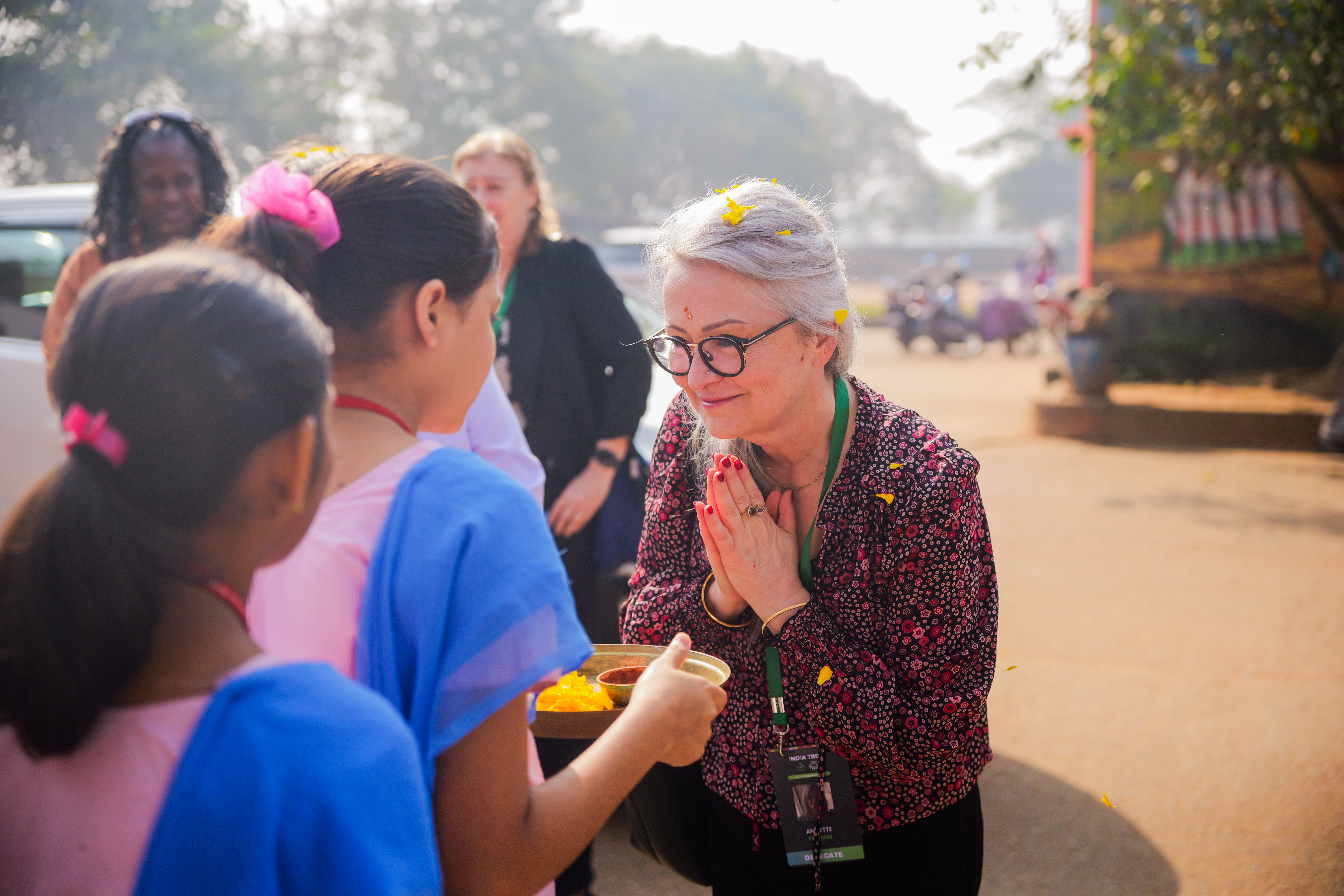
Connecting people in the United States and India is central to the Center’s mission. The Center advances this goal by fostering sustained, reciprocal relationships between faculty, students, and academic institutions in both countries.
Through academic exchanges, immersive programs, and institutional partnerships, the Center creates opportunities for meaningful engagement with contemporary India—supporting cross-cultural learning, collaborative scholarship, and long-term relationships that extend beyond a single course or visit.
Our exchange programs include:
KIIT & KISS
In partnership with Kalinga Institute of Industrial Technology (KIIT) and the Kalinga Institute of Social Sciences (KISS), the Center supports faculty engagement focused on interdisciplinary learning, social impact, and inclusive education.
In 2025, the Center led a combined India Trek and Global Faculty Programme delegation to KIIT and KISS, bringing together faculty and staff from all seven colleges at Seattle University. The delegation strengthened institutional relationships and laid the foundation for future student opportunities, curriculum development, and collaborative research.
Read the delegation highlights report. Watch the highlights video.
O.P. Jindal Global University (JGU)
Seattle University's School of Law maintains a long-standing academic partnership with O.P. Jindal Global University, supporting two-way student exchange and people-to-people connections.
Students in India
Seattle University students study at Jindal to gain direct exposure to India’s legal, political, business, and social systems through immersive, academically rigorous programs.
-
Indian Law and Legal Institutions: Artificial Intelligence and Access to Justice (1 credit), Professor LeighAnne Thompson
For this course, Seattle University J.D. students will travel to New Delhi, India where they will take classes at our partner institution, Jindal Global Law School during the Spring Break of 2025. The course will use a comparative framework to explore how the Indian legal system compares to the U.S. legal system with respect to the ethical use of AI in the practice of law, and AI’s potential to expand access to justice. Through this lens, students will learn various areas of Indian law and Indian legal history and learn about how Indian legal institutions function. In addition to classroom instruction, students will visit Indian courts and historical monuments and other relevant places around New Delhi and Agra. Students will submit a 10-to-15-page reflection paper on the topic of ethical AI and access to justice no later than three weeks after returning to Seattle. Course is open to J.D. students second year or above.
Students in the U.S.
Jindal students engage in academic experiences at Seattle University, bringing global perspectives to the classroom and deepening campus understanding of contemporary India and the Indian diaspora.
- AI, Law, and Technology
In July 2025, Seattle University Law School hosted 30 students from Jindal Global Law School for a short course on "AI, Law, and Technology." The cohort visited major offices and firms, such as Microsoft and Perkins Coie, and heard from legal thought leaders of Seattle.
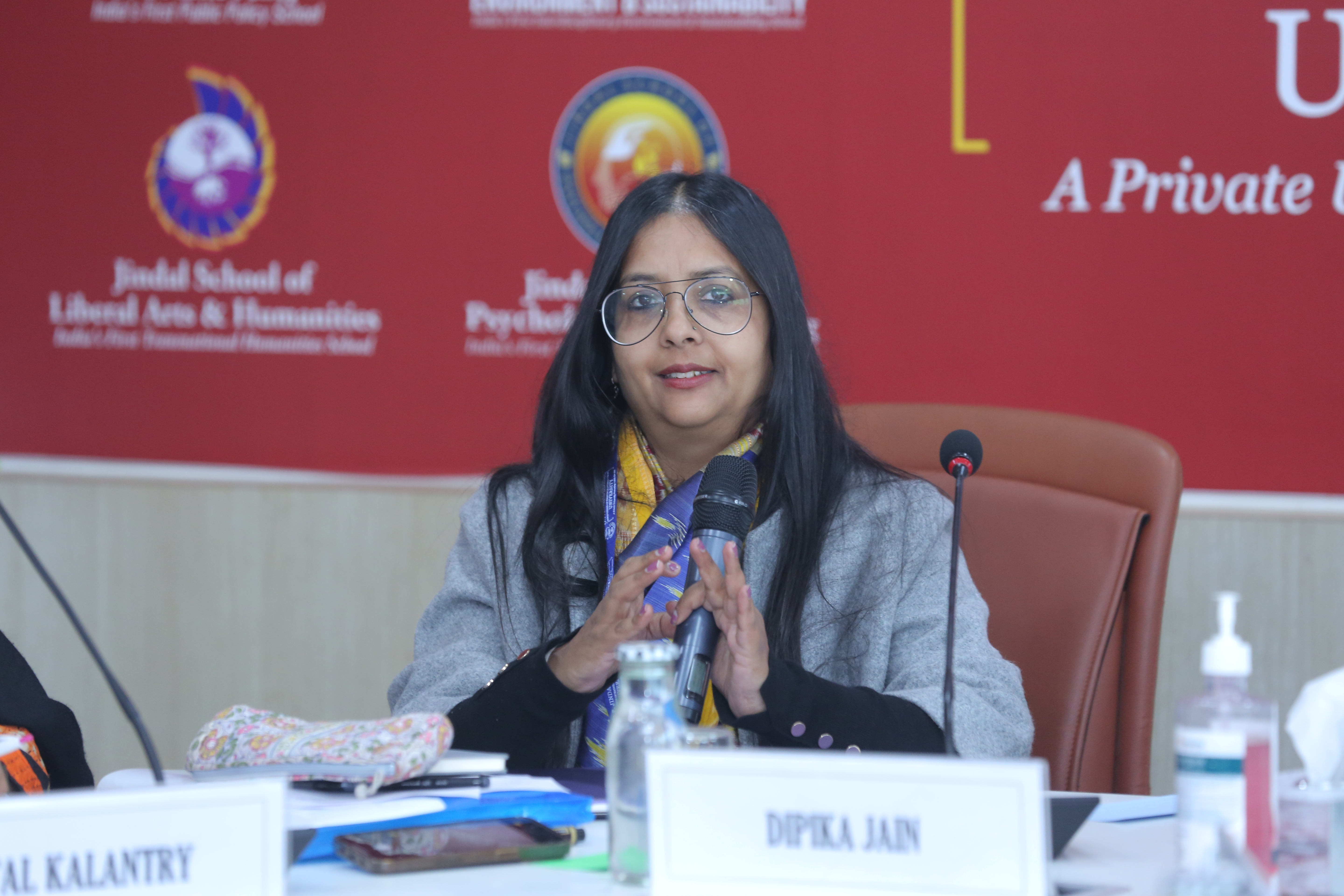
Despite constitutional guarantees, Indian women from marginalized backgrounds encounter significant barriers in accessing justice due to factors like violence, economic inequality, and access to legal resources. The Access to Justice project—led by an interdisciplinary team from Jindal Global University’s Centre for Justice, Law & Society and Seattle University’s Roundglass India Center—aims to address these issues in the Mohali district of Punjab.
The project is unique in its focus on women and the intersectional identities that make up their lived experience including religion, caste, class, sexuality, and ethnicity. The project ambitiously aims to “map out” participants’ experiences by neighborhood, community, and geographic location to identify similarities and differences. The project endeavors to go beyond simply identifying obstacles to women’s access to justice to also develop practical, actionable solutions for meaningful change.
Contact Us
Roundglass India Center
Follow us on social media: @roundglassindiacenter
LinkedIn | Instagram | Facebook | YouTube