Transparency in Learning and Teaching (TILT)
An achievable and high-impact practice to improve student success in your courses

Here you'll learn how an achievable change to your assignment design can significantly improve student success. You'll learn both the evidence of impact behind this practice and how to make this change for your own courses.
Scroll down to find:
- A brief overview of Transparency in Learning and Teaching (TILT) as a model for assignment design
- Evidence of impact and benefits to students and faculty
- The elements of a "TILTed" assignment
- Step-by-step instructions for how to TILT your course assignments
- Common questions and critiques of TILT
Request a consultation about TILT
What is TILT?
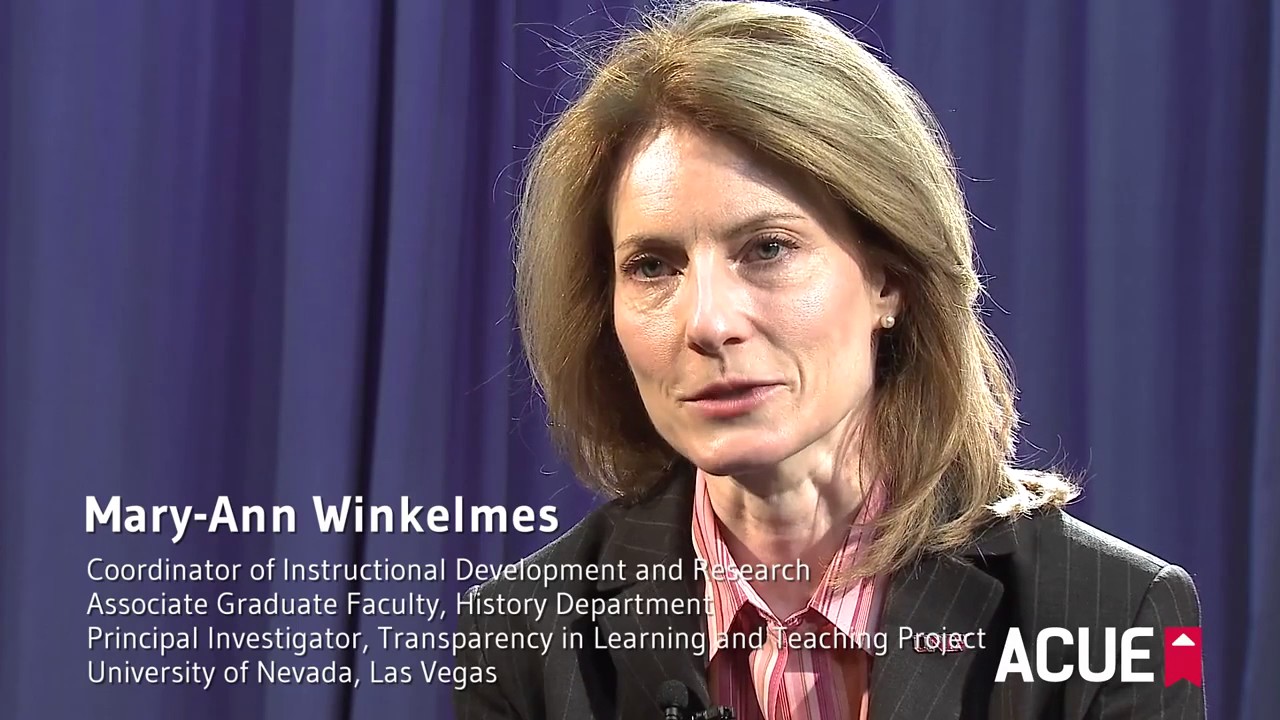
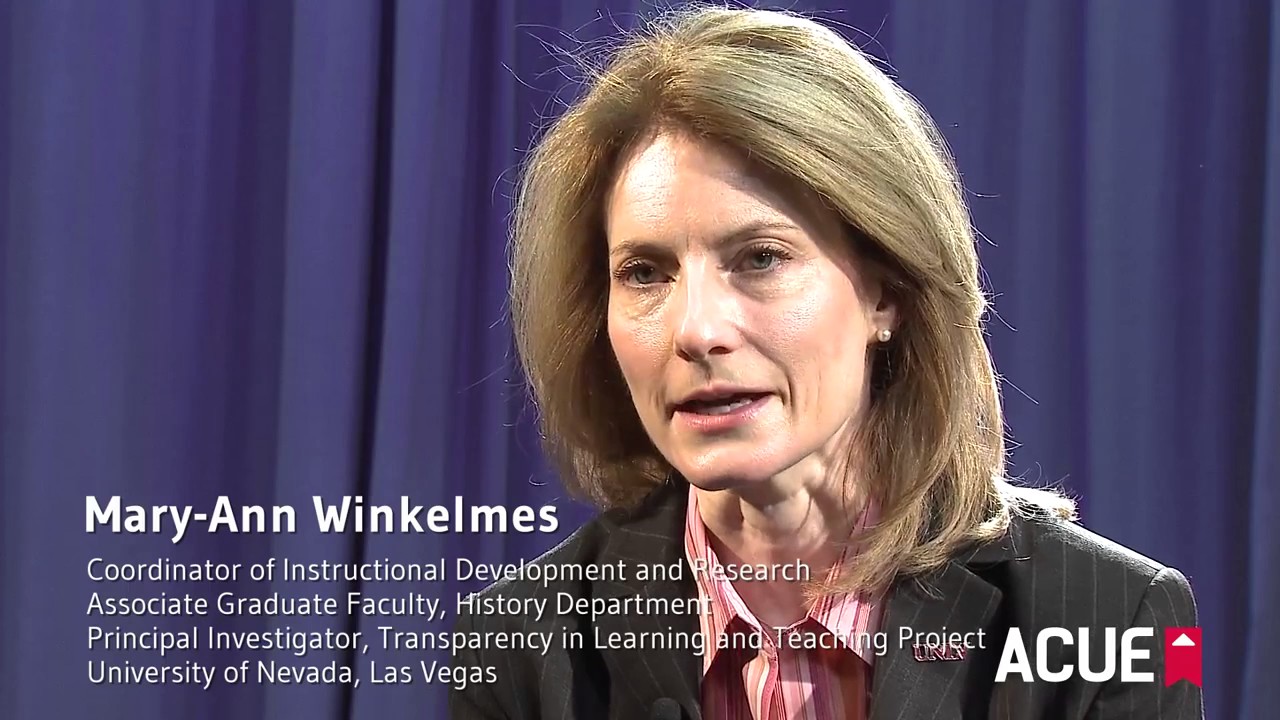
Dr. Mary-Ann Winkelmes and her colleagues created the TILT (Transparency in Learning and Teaching) framework to foster more equitable learning experiences for all students. Listen to learn more.
Unwritten Rules for College Success, 39 second video
What does a TILTed assignment look like?
Students will have a clear understanding of what knowledge and/or skills they will gain from completing the assignment.
To help you think about what skills students will gain, you can use our Student Career Readiness Inventory of competencies and skills.
Purpose - Transparency Framework, 44 second video
Students know what to do, step-by-step, to complete the task successfully. (You might also include how not to complete the task, based on your own experience of common student errors in the past.)
If students have clarity about where the challenge should like in an assignment, they should feel more confident in their learning process and focus their energies appropriately.
Task - Transparency Framework, 25 second video

Students have access to (a) assessment rubrics/grading criteria and, where possible, (b) examples of past completed assignments so that they know what success can look like.
Criteria - Transparency Framework, 24 second video
Answers to Common Questions & Critiques About TILT
TILT doesn't mean giving away answers. Rather, the model clarifies assignment purpose, task, and criteria.
There's a meaningful difference between telling students what to think and telling them how to approach thinking. A mystery novel isn't less engaging because the back cover tells you it's a thriller. Similarly, students who understand why they're doing an assignment and what success looks like are more motivated to engage deeply, not less.
The cognitive challenge of the assignment remains fully intact; you're just removing the guesswork around logistics and expectations.
Not at all! You're actually making the intellectual demand more visible, not less.
When students spend cognitive energy decoding assignment instructions, that energy is diverted away from the actual learning. TILT removes unnecessary obstacles so students can focus on the intended ones.
Research by Winkelmes et al. (2016) found that transparent assignments raised achievement across all students, with the greatest gains among first-generation and underrepresented students, a sign of equity, not lowered standards.
This is a signal to reorganize, not to add more.
If articulating purpose, task, and criteria feels lengthy, it's often because those elements were previously scattered across syllabi, slides, verbal instructions, and the assignment sheet itself. TILT encourages consolidating that information into one clear, student-facing document. Concise, well-organized transparency is the goal.
Hearing something in class and having a reliable reference document are two different things.
Verbal and slide-based instruction is ephemeral - students take imperfect notes, miss class, or simply can't reconstruct instructions under deadline pressures.
A written, transparent assignment sheet gives students something concrete to return to. It also acknowledges that students are managing multiple courses simultaneously, and what feels repetitive to an instructor may be one of many competing demands on a student's attention.
Clarity in writing reduces the volume of "what do I do?" emails to you, too.
Well-designed TILT criteria focus on skills and thinking processes, not surface features, thus gaming a well-designed rubric isn't possible. In fact, rubrics can be informative for students.
For example, telling students up-front exactly where the intellectual challenges lie, you are helping them go deeper. Students who engage deeply with transparent criteria tend to produce stronger work.
Even experienced learners benefit from clarity, especially when entering a new discipline. Transparency about purpose helps advanced students understand how a task connects to larger professional or scholarly goals, which can actually raise the intellectual stakes.
Being transparent may include letting students know that they are dealing with a messy problem that has no obvious single answer. The challenge in that situation is to handle the ambiguity and use best judgment based on students’ learning of the subject.
There's a meaningful difference between learning disciplinary conventions (a legitimate goal) and decoding unstated expectations (an inequitable barrier). In a TILTed assignment you can make “learning disciplinary conventions” an explicit learning objective rather than a hidden hurdle. And when “figuring something out” is part of the assignment itself, state as much, including where in the assignment students are meant to struggle and try to figure it out on their own.
References and Resources
Copeland, D. E., Winkelmes, M.-A., & Gunawan, K. (2018). Helping students by using transparent writing assignments. In T. L. Kuther (Ed.), Integrating writing into the college classroom: Strategies for promoting student skills (pp. 26–37). Society for the Teaching of Psychology.
Howard, T. O., Winkelmes, M.-A., & Shegog, M. (2019). Transparency teaching in the virtual classroom: Assessing the opportunities and challenges of integrating transparency teaching methods with online learning. Journal of Political Science Education, 16(2), 198–211.
Winkelmes, M.A., Bernacki, M., Butler, J., Zochowski, M., Golanics, J., Harris Weavil, K. 2016. A Teaching Intervention that Increases Underserved College Students’ Success. Peer Review 18 (1).
Winkelmes. M.A., Copeland, D.E., Jorgensen, E., Sloat, A., Smedley, A., Pizor, P., … Jalene, S. 2015. Benefits (some unexpected) of transparently designed assignments. The National Teaching and Learning Forum, 24 (4), 4-7.
Yong, D. 2017. How Transparency Improves Learning. Teaching Tidbits (Mathematical Association of America blog).