/181x0:2219x1300/prod01/channel_34/media/seattle-university/news--stories/images/Netty-award-duo-with-graphic.jpg)
Artists Sangram Majumdar and Jo Cosme
As funding for the arts grows increasingly fragile, the Neddy Award offers sustained support for artists pushing boundaries.
Two artists working across distinct visual languages—but united by a commitment to inquiry, perception and lived experience—have been named recipients of the 2026 Neddy Artist Award, one of the most significant and longstanding awards for visual artists in the Puget Sound region.
Stewarded by Cornish College of the Arts at Seattle University and funded by the Behnke Foundation, this year’s Neddy provides two unrestricted awards of $30,000 alongside six $3,000 awards in additional finalist support. Now in its 30th year, the Neddy continues to recognize artists whose practices engage deeply with material, meaning and community.
“It was an honor and joy to be the Neddy Award juror this year,” says National Juror Daisy Nam, who visited each finalist’s studio. “Each and every one of the artists had a unique vision, cultivated by their ongoing dedication to their craft and practice.”
Selected for the 2026 Neddy are Jo Cosme (open medium) and Sangram Majumdar (painting), citing the urgency, rigor and emotional depth present in both practices.
For Cosme, the award will directly expand an ambitious, evolving body of work.
“This award will allow me to expand the Welcome to Paradise and to begin traveling with it in a more sustained and intentional way,” Cosme says. “That mobility is central to the work, as the conversations it holds around land, displacement and the construction of paradise shift depending on where it is experienced.”
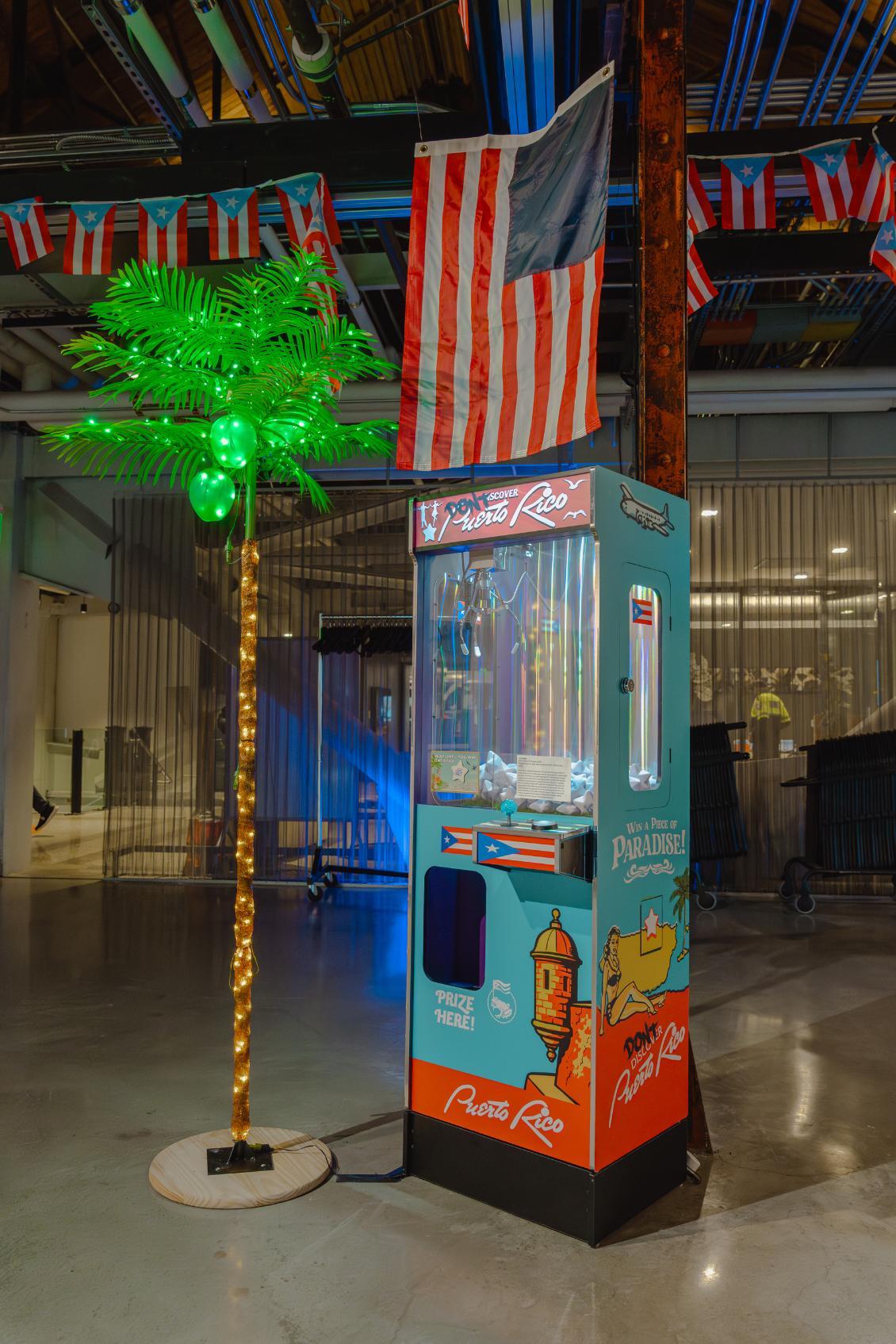
Part of the art installation by Jo Cosme.
During a visit to Cosme’s studio, Nam described Welcome to Paradise—an immersive multimedia installation—as a “maximalist approach … that was also playful, educational, emotional and critical,” incorporating participatory installations, sculptural elements and photographic works. She noted how the work reveals “the tactics of colonization … through a board game, inflatable sculptures, holographic photographic works, vending machines with trading cards and much more.” Adds Nam, “I sensed her urgency and passion, along with love, anger and longing pulsing through the works.”
Cosme’s submitted work interrogates how Puerto Rico is constructed and consumed as “paradise,” asking “who benefits from that image and who is pushed out in the process.” Drawing on materials such as “blue hurricane tarps, dominoes, tourism signage and folkloric figures like the vejigante,” the work holds “tension between celebration and exploitation, visibility and erasure.”
That tension extends into lived experience. As a displaced Boricua artist working in the United States, Cosme described the responsibility embedded in the work: “I’m also making this work in the same country that continues to control and exploit my own, so there’s a big responsibility that comes with that… The People of Borikén, Puerto Rico, are meant to stay in our Land and we will not be erased or pushed out.” The Neddy Award, Cosme adds, affirms that “those of us coming from non-linear, unconventional paths … also belong in these spaces.”
For Majumdar, the Neddy arrives at a moment of expansion. “It provides a sense of permission to push further into complexity,” he says, describing a practice increasingly focused on ambiguity and perception. His recent work explores the idea of the “monster” as a shifting cultural construction shaped by fear, fascination and the instability between representation and misrepresentation.
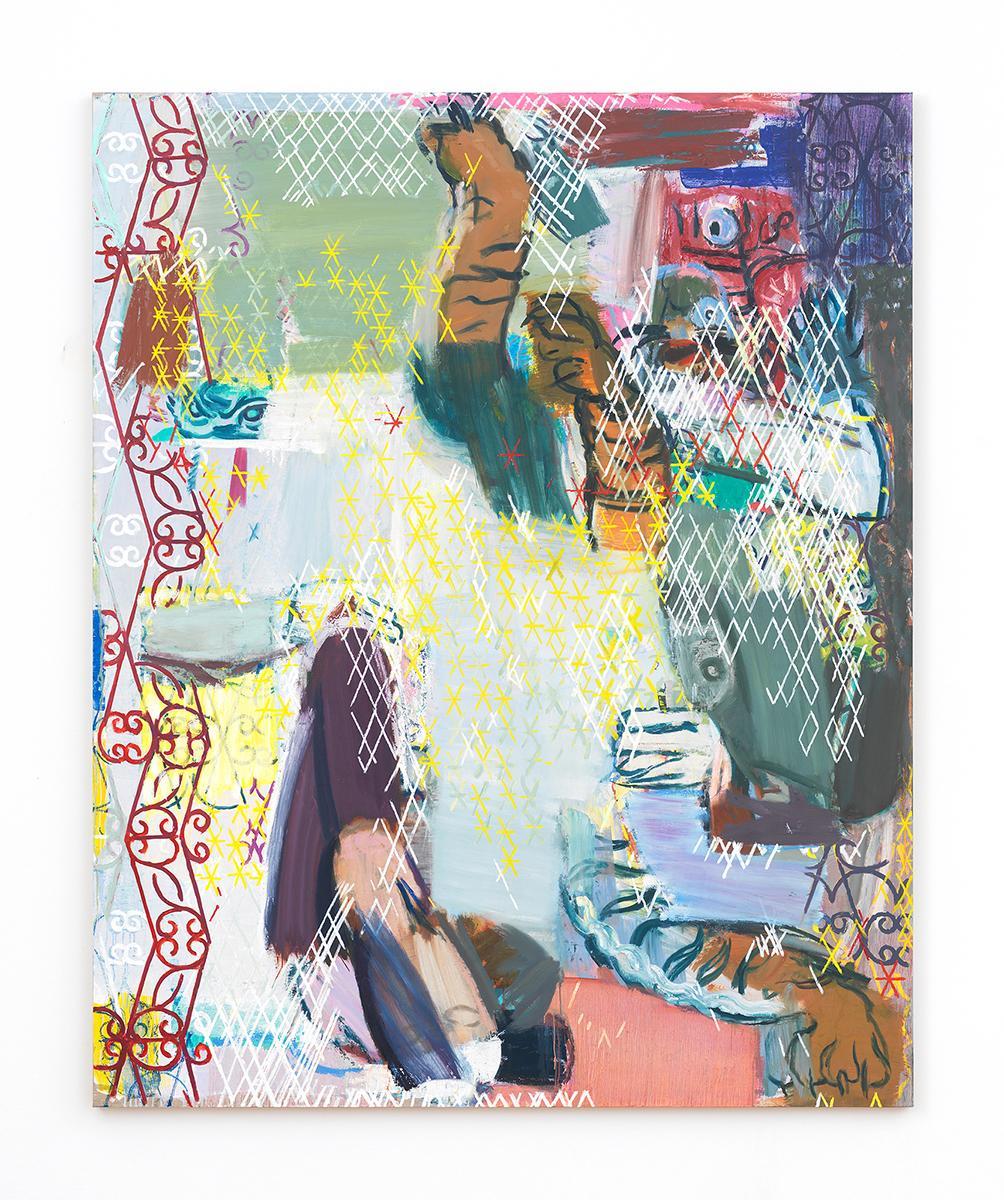 A painting by Sangram Majumdar.
Nam described being immediately drawn into Majumdar’s paintings: “The act of looking is a journey in and through the painting … There is always a way out.” She also noted his “deep and saturated” use of color and his interest in expanding spatial investigations beyond painting into installation.
Moving between crowds, hybrid figures and charged bodily gestures, Majumdar examines how viewers project meaning onto what they see. His work asks how “uncertainty, fear, fascination, belief and actions shape our perception and how we ultimately relate to one another.”
Both artists emphasize the importance of sustained support in an increasingly precarious landscape for arts funding.
“With so many cuts right now, something like the Neddy carries more weight than usual,” Cosme says. “It’s not just recognition; it’s real support that helps you keep going. The Neddy helps keep space open for that work to exist and be seen.” Majumdar echoes this, sharing that such awards “allow for open ended research” and underscore “the role of regional institutions in maintaining a viable cultural ecosystem.”
As part of a cohort of eight finalists, both artists also reflect on the value of a rich artistic community. For Cosme, the experience reshaped a sense of belonging: “Artistic community doesn’t have to come from sameness, but from a willingness to engage, exchange and support each other’s work.” Majumdar, still relatively new to the region, pointed to opportunities for deeper dialogue that could “bring new people into the fold.”
Together, their practices reflect the layered, evolving cultural landscape of the Puget Sound. Cosme’s work asks viewers to reconsider “their relationship to place and land and to the systems that connect the Pacific Northwest to the Caribbean,” while Majumdar continues to explore the shifting terrain of perception within a region he is still coming to know.
In honoring both artists, the Neddy Artist Award continues its legacy of supporting work that challenges, expands and deepens the conversations shaping contemporary art in the region.
Similar News & Stories
-
/0x436:1130x1150/prod01/channel_34/media/seattle-university/news--stories/images/Student-Spotlight-Julia-photo-Oct-10-1130X1585.jpeg)
She's Got Spirit
SU NewsJulia Spuck is honored for her enthusiastic support of all things SU and as an inspiration to many. -
/0x42:2400x1558/prod01/channel_34/media/seattle-university/news--stories/images/Costco-Scholars-SU-speaker.jpeg)
Empowering Student Success
SU NewsAnnual Costco Scholarship Breakfast breaks record, raising $8.4 million in support of student scholarships. -
/0x57:1200x815/prod01/channel_34/media/seattle-university/news--stories/images/Semester-wins-military-photo.jpeg)
On the Right Path
SU NewsMove to semesters will benefit veteran and military-affiliated students beyond graduation.